
- Published Works
Books & Publications
Explore research-based insights and practical guidance on creativity, education, and AI technology through Matthew Worwood’s published works.
Each book combines academic rigor with actionable strategies, making complex concepts accessible to educators and leaders. From classroom teachers to administrators, these publications provide frameworks and tools for fostering creativity in educational settings.one that inspires curiosity, adaptation, and openness to new possibilities.
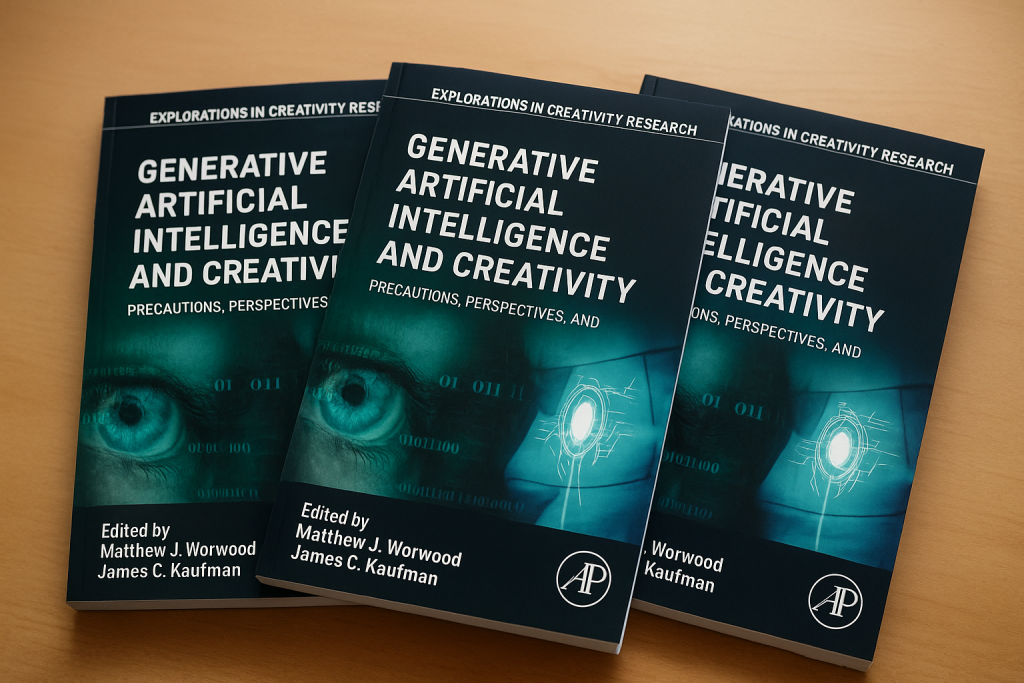
Latest Publication
This book explores a wide range of topics at the intersection of generative AI and creativity
4.5
93 reviews
Generative Artificial Intelligence and Creativity: Possibilities, Precautions, and Perspectives
Matthew J Worwood & James C Kaufman
Generative Artificial Intelligence and Creativity: Possibilities, Precautions, and Perspectives explores the dynamic relationship between generative AI (genAI) and creativity. This book brings together global scholars from diverse fields to explore the transformative impact of genAI on human creativity. As technological advancements in genAI continue to accelerate, this book navigates through the complexities of understanding and harnessing its potential. Generative Artificial Intelligence and Creativity not only dissects the fundamental principles underlying AI’s contribution to creativity but also addresses the paradoxical impact of AI on human creative industries. This book serves as a unique guide for anyone seeking to comprehend the implications of AI on the future of human creativity.
- Published: December 19, 2025
- Publisher: Academic Press
- 250 Pages
- ISBN-10: 0443340730
Scholarly Articles and Chapters
Writing at the intersection of creativity, design, technology, and education.
Published
Chapter - Academic Press
2026
The convenience trap: How AI could hinder creativity in education
Matthew J. Worwood
Generative AI (GenAI) is a multipurpose technology with many known and unknown applications in education settings. Already, we have witnessed use cases as a writing tool, a reading tool, an assessment tool, and a chatbot that can assist in generating ideas. The latter has become a focus in creativity research, with the field considering its capacity to outperform humans on divergent thinking tests and practitioners considering how best to train students to use it to support learning and creativity. This interest suggests a classroom (now or in the future) where students may outsource certain aspects of the cognitive process to personalized chatbots that can produce various outcomes in seconds. While this situation might offer undeniable convenience and efficiency to help complete projects, it fails to consider the potential dangers to human development and creativity in the classroom: overreliance on AI-generated ideas may hinder the growth and potential of crucial skills that support creativity. Consequently, by reducing the need for independent ideation and focusing instead on selecting pregenerated options, could we be sacrificing the very processes that we have so long advocated for in the field of education? This chapter will initiate a reflective conversation about the responsible integration of AI tools in the classroom by considering the lessons learned (or not learned) from past technology disrupters and proposing two different responses to a single learning event: one with the use of GenAI and one without. The chapter will then consider the long-term implications of GenAI on student learning and creativity.
Worwood, M. J. (2026). The convenience trap: How AI could hinder creativity in education. In M. J. Worwood & J. C. Kaufman (Eds.), Generative artificial intelligence and creativity: Possibilities, precautions, and perspectives (pp. 179–192). Academic Press.
Published
Article - Possibility Studies & Society
2023
Introducing the CAUSE model and five Creativity Languages
Matthew J. Worwood & James C Kaufman
There are many approaches to understanding how creativity is manifested, from the influence of the context or environment to understanding differences in processes or domains. However, less work has focused on a creator’s instinctual reaction to external stimuli and how it shapes the creative activities that follow. This paper proposes the CAUSE Model of Creativity Languages: Connect, Apply, Understand, Share, and Express. The authors consider how an individual’s varying levels across these five Creativity Languages (innate, proficient, independent, basic, or dormant) may influence creative behavior, choice of domains to pursue, and potential eventual success. The model is also discussed in terms of potential measurement as well as how it could intersect with the Four C’s Model of creativity, including how Pro-c creators would benefit from understanding all five Creativity Languages.
Worwood, M. J., & Kaufman, J. C. (2023). Introducing the CAUSE model and five Creativity Languages. Possibility Studies & Society, 1(3), 380-396. https://doi.org/10.1177/27538699231182879 (Original work published 2023)
Published
Chapter - Routledge
2022
A Pragmatic View of Teaching and Measuring Creativity Inside Digital Media Design
Matthew J. Worwood
Design thinking’s emphasis on the end-user makes it more suitable to design disciplines when compared to other forms of creative problem-solving. Teaching creativity inside design thinking requires teaching practitioners to consider the influence of audience members who exist inside and outside the classroom environment. Students must learn how to differentiate feedback from audience groups that exist inside the classroom environment and consider their limitations in effectively judging the likelihood of an outcome’s success in the real world. The 4C framework for creativity provides a pragmatic approach to exploring different ways to evaluate outcomes when teaching creativity in Digital Media Design.
Worwood, M. J. (2022). A pragmatic view of teaching and measuring creativity inside Digital Media Design. In Plucker, J. (Eds.), Creativity and Innovation: Theory, Research, and Practice. (pp. 133-148). New York: Taylor & Francis. doi: 10.4324/9781003233923
Published
Chapter - IGI
2021
Four Steps to Promote Teacher Creativity When Making the Transition to Virtual Learning Experiences
Matthew J. Worwood
This chapter presents four steps for teacher creativity as part of a design-based approach to problem-solving pedagogical challenges using virtual learning environments. Building on existing practices found in creative problem-solving and design thinking methodology, these steps explore change as a journey that begins with an intent to produce an outcome that improves a specific aspect of the learning experience. Glaveanu’s five-A framework provides a sociocultural perspective to support the concept of teacher creativity in the classroom, while Kaufman and Beghetto’s 4-C model serves as a developmental approach to evaluating outcomes based on the impact they have in the environment. Future opportunities for study, including integrating learning analytics and situating the different stages of creative problem-solving in education, are also discussed.
Worwood, M. J. (2021). Four steps to promote Teacher Creativity when making the transition to virtual learning experiences. In Niess, M., L. & Gillow-Wiles, H. (Eds.), Handbook of research on transforming teachers’ online pedagogical reasoning for engaging K-12 students in virtual learning, (pp. 126-147). IAG-Global. doi: 10.4018/978-1-7998-7222-1
Published
Chapter - Springer
2017
Creativity, Design Thinking and Interdisciplinarity
Matthew J. Worwood & Jonathan A Plucker
An emphasis on design thinking is increasingly prevalent in both professional and educational settings. From maker spaces to prototyping labs to the infusion of creative design thinking into K-12 instruction, principles of design thinking are making their way into a range of educational contexts and interventions. Many of these initiatives are based on creative thinking research and activities, making this research base relevant to the design of design-based educational interventions. In particular, the domain-specific and domain-general aspects of creativity have been studied and debated for decades, and a limited consensus has emerged on the extent to which creative thinking requires a mix of specific and general skills and personal characteristics. But little work has been done to explore the extent to which this previous theoretical and empirical work applies to creative design thinking, yet assumptions about the domain and task specificity of creative design thinking (or lack thereof) have a significant impact on both short- and long-term effects of design-based interventions. In this chapter, we review existing literature on creativity and domain specificity and then examine the degree to which that work is relevant to creative design thinking. Similarities and differences provide insight into design thinking in general and in creative contexts in particular. The chapter ends with an exploration of the implications of the research for teaching creative design thinking and which domain-general skills are particularly applicable.
Worwood, M. J., & Plucker, J. (2018). Domain generality and specificity in Creative Design Thinking. In Darbellay, F., Moody, Z., Lubart, T. (Eds.), Creativity, Design Thinking and Interdisciplinarity, (pp. 83-91). Singapore: Springer. doi: 10.1007/978-981-10-7524-7
Published
Conference Proceeding - Immersive Education
2012
The 10 Cube Challenge: Using Virtual Worlds to Foster Creative Thinking
Matthew J. Worwood & Frank Labanca
3D virtual worlds foster creativity through the development of a creativity skill set, as identified by E. Paul Torrance. Using a blended learning approach, which leverages both face-to-face and computer-mediated interactions, high school students participated in scaffolded curricular inquiry-based activities that introduced basic mathematic principals to working in 3D environments, while deliberately providing students with an opportunity to develop creative thinking. Entitled the 10 cube challenge, students were required to develop a model using exactly 10 cube, or cubid shaped, primitive objects to replicate the shape of a real world object.
Worwood, M., & LaBanca, F. (2012). The 10 Cube Challenge: Using virtual worlds to foster creative thinking. iED 2012 Proceedings: Immersive Education. ImmersiveEducation.org.